
Accra, July 9, 2025 – The Government of Ghana, through the Ministry of Foreign Affairs, has issued a press release addressing widespread reactions to the country’s abstention in a United Nations Human Rights Council vote on July 7, 2025. The vote, part of the 59th session of the Human Rights Council (#HRC59), renewed the mandate of the Independent Expert on Protection Against Violence and Discrimination Based on Sexual Orientation and Gender Identity (A/HRC/59/L.2). Ghana’s decision to abstain, alongside two other countries, has sparked debate, with critics like Assin South MP Reverend John Ntim Fordjour labelling it “absurd” and demanding a vote against the resolution.
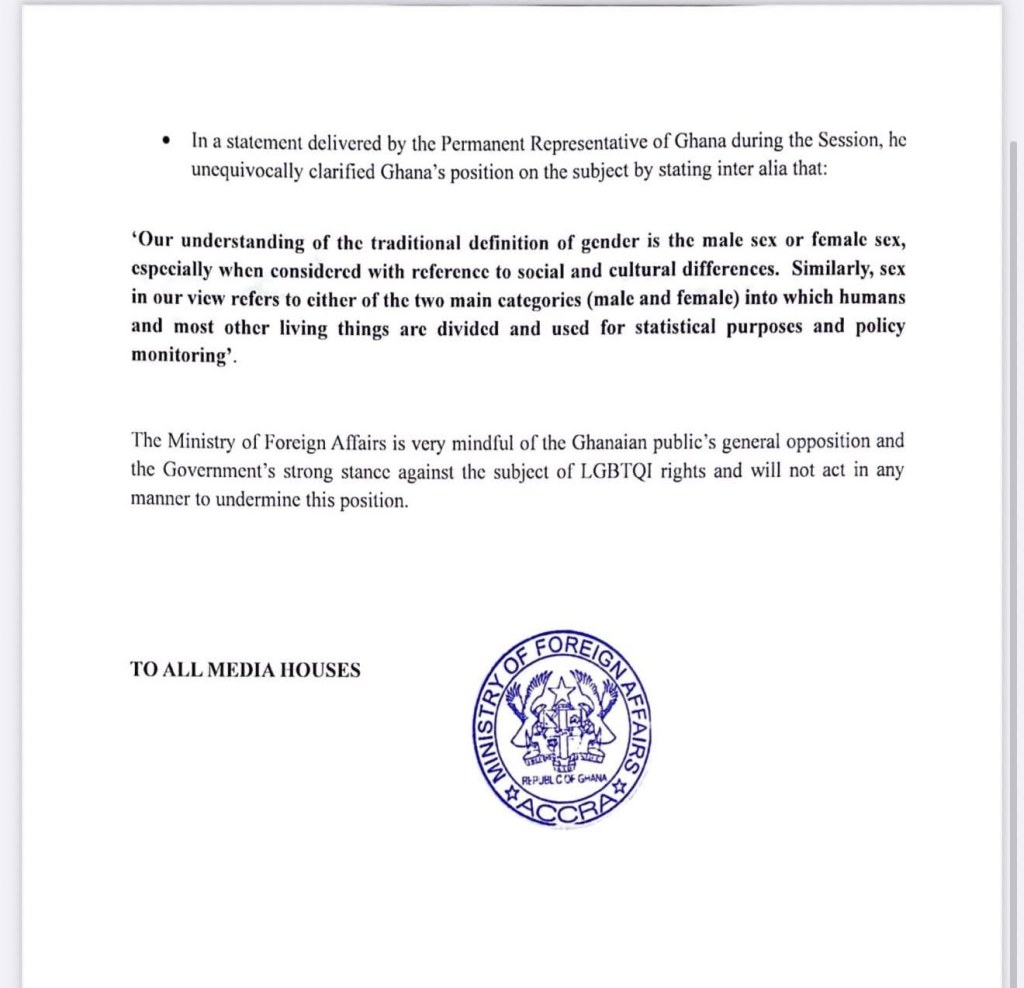
In a press release dated July 9, 2025, the Ministry of Foreign Affairs clarified that Ghana’s abstention was not a vote on supporting LGBTQ+ rights, as some media reports suggested, but rather on whether individuals identifying as LGBTQ+ should be protected from violence and discrimination. “There was no vote on the support of LGBTQI for which Ghana abstained as has been wrongly reported by a section of the Ghanaian media,” the statement read. The resolution, which passed with 29 votes in favour and 15 against, mandates the Independent Expert to continue annual reporting to the Human Rights Council and General Assembly.
The Ministry justified Ghana’s abstention by citing consistency with Chapter 5, Article 17 of the 1992 Constitution, which prohibits discrimination based on gender, race, color, ethnic origin, religion, creed, or social and economic status. During the HRC session, Ghana’s Permanent Representative emphasized the country’s traditional understanding of gender as binary—male or female—based on biological sex, stating, “Our understanding of the traditional definition of gender is the male sex or female sex, especially when considered with reference to social and cultural differences.”
The press release also addressed domestic concerns, acknowledging “the Ghanaian public’s general opposition and the Government’s strong stance against the subject of LGBTQI rights.” The Ministry assured citizens that it would not undermine this position, responding to criticisms from figures like Rev. Ntim Fordjour, who, in a July 8 X post, accused President John Dramani Mahama of shifting away from Ghana’s conservative values. The MP referenced a recent incident involving a South African same-sex couple kissing under the Independence Arch, which he called a “desecration,” and urged faith-based organizations, the National House of Chiefs, and citizens to rally in support of the pending “Human Sexual Rights and Family Values Bill.”
The anti-LGBTQ+ bill, reintroduced in the 9th Parliament in 2025, seeks to criminalize same-sex relationships, advocacy, and related activities. It has drawn international condemnation and warnings of economic repercussions.
The government’s abstention is seen by some as a diplomatic move to balance domestic sentiments with international relations, avoiding direct opposition to the resolution, which could strain ties with pro-LGBTQ+ rights nations and organizations.
Supporters of the government’s stance argue that abstaining was a pragmatic choice, aligning with Ghana’s constitutional framework while maintaining diplomatic neutrality. The renewed UN mandate calls for member states to protect the rights of individuals with diverse sexual orientations and gender identities, a position that contrasts with Ghana’s proposed legislation and public sentiment.
As the debate intensifies, the Mahama administration faces mounting pressure to navigate cultural values, human rights obligations, and global diplomacy. The Ministry’s press release underscores its commitment to Ghana’s traditional stance but leaves open questions about how the government will address the pending anti-LGBTQ+ bill and its implications for Ghana’s international standing.
Below is a copy of the press release:

 Rightify Ghana