

The University of Ghana (UG) has issued a forceful rebuttal to claims by prominent anti-LGBTQ+ advocate Moses Foh-Amoaning that the institution amended its statutes to endorse or admit LGBTQ+ activities, labeling the accusations as “entirely false, misleading, and defamatory.” In a detailed statement released on November 24, 2025, UG clarified that recent changes to its governing documents were merely linguistic updates to adopt gender-neutral language, and demanded an immediate retraction and public apology from Foh-Amoaning, warning of legal action if unmet. The university also slammed irresponsible media reports for amplifying unverified claims without proper verification.
The controversy stems from Foh-Amoaning’s remarks during a November 21, 2025, interview on Onua FM’s “Yen Nsempa” program, where the Executive Secretary of the National Coalition for Proper Human Sexual Rights and Family Values alleged that UG’s leadership, including its Vice-Chancellor, had revised admission policies to accommodate transgender and LGBTQ+ students.
He cited this as evidence supporting the urgent passage of Ghana’s Human Sexual Rights and Family Values Bill, a contentious piece of legislation aimed at criminalizing LGBTQ+ advocacy, promotion, and related activities with severe penalties. Foh-Amoaning, a vocal proponent of the bill, claimed the changes were ignored in responses to his coalition’s inquiries and framed them as a threat to Ghanaian family values.In its response, UG emphasized that the 2024 review of its statutes adhered strictly to national laws and university regulations, with no deviations or introductions of provisions endorsing LGBTQ+ activities.
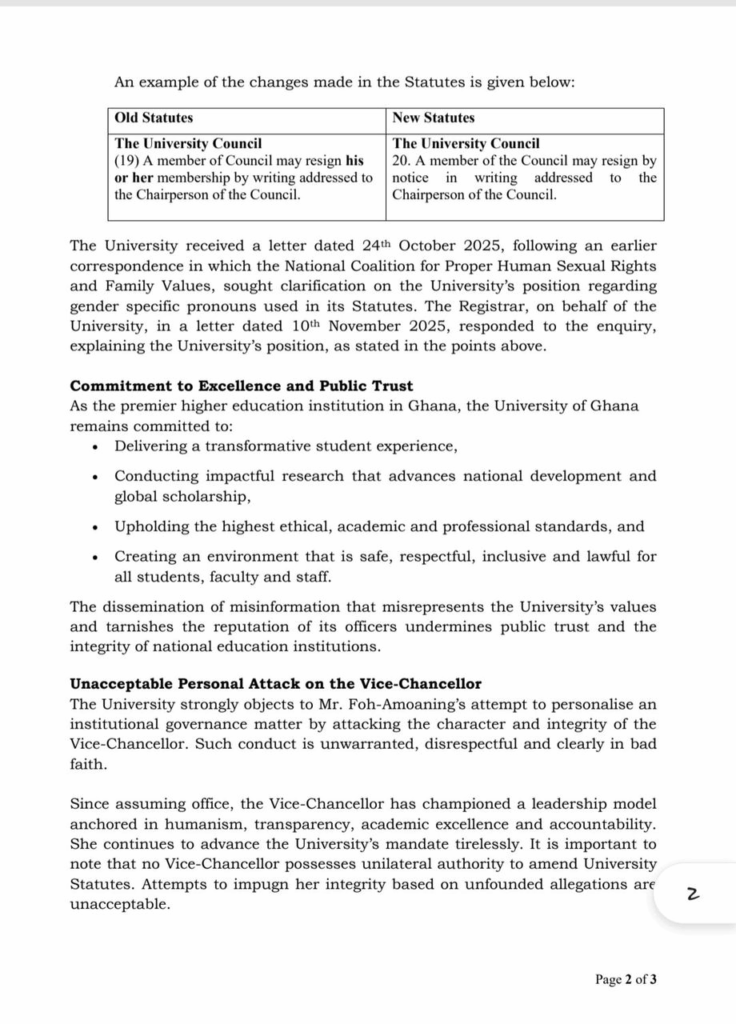
“The revised Statutes of the University do not depart from national law, nor do the statutes introduce any provision that endorses, promotes, or ‘admits’ LGBT+ activities as alleged,” the statement read. It detailed that the modifications involved replacing gender-specific pronouns like “he,” “his,” “she,” or “her” with neutral terms such as “they” and “their” to eliminate repetitive phrasing and promote inclusivity in language without altering substantive policy.
To illustrate, UG provided an example: An old statute reading, “A member of Council may resign his or her membership by writing addressed to the Chairperson of the Council,” was updated to, “A member of the Council may resign by notice in writing addressed to the Chairperson of the Council.” The university noted these revisions align with modern English language developments over the past two decades, citing the 2011 New International Version (NIV) of the Bible, which uses singular “they/them” in passages like James 4:17: “If anyone, then, knows the good they ought to do and doesn’t do it, it is sin for them.”
UG also addressed the coalition’s correspondence, confirming it received a letter dated October 24, 2025, following an earlier inquiry, and responded on November 10, 2025, explaining its position. The statement reaffirmed the university’s commitment to delivering transformative education, conducting impactful research, upholding ethical standards, and fostering a safe, respectful, inclusive, and lawful environment for all students, faculty, and staff.
A significant portion of the rebuttal condemned Foh-Amoaning’s personal attacks on Vice-Chancellor Prof. Nana Aba Appiah Amfo, whom he had described as “a woman who goes to church” in his allegations. UG described such conduct as “unwarranted, disrespectful, and clearly in bad faith,” highlighting her leadership anchored in humanism, transparency, academic excellence, and accountability. “No Vice-Chancellor possesses unilateral authority to amend University Statutes,” the statement asserted, adding that attempts to impugn her integrity based on unfounded claims are unacceptable.
The university further called out media outlets, including GhanaWeb and Onua FM, for amplifying unverified claims, urging responsible reporting to avoid spreading misinformation. “The amplification of unverified claims does not serve the public interest and risks misleading the public,” it stated, recommending verification through UG’s Public Affairs Directorate before publication.As of November 25, 2025, there has been no immediate public response from Foh-Amoaning or his coalition to UG’s demands.


Human rights advocates have welcomed UG’s clarification, viewing it as a stand against baseless fearmongering amid ongoing debates over the anti-LGBTQ+ bill, which remains pending under President John Dramani Mahama, who has pledged to sign it if advanced in the Parliament of Ghana.
This incident underscores the heightened tensions in Ghana surrounding LGBTQ+ rights, where existing laws already criminalize same-sex acts, and proposed legislation could further restrict advocacy. UG’s firm stance may set a precedent for other institutions, while the threat of legal action highlights the potential for escalation in this polarizing discourse.
 Rightify Ghana