Council stresses no LGBTQ content in curriculum, clarifies revision of SRH material, and situates controversy within Ghana’s long history of politicised attacks on sexuality education
The National Council for Curriculum and Assessment (NaCCA) has issued a detailed statement responding to allegations made by Hon. John Ntim Fordjour, Member of Parliament for Assin South Constituency and former Deputy Minister for Education, who accused the government of inserting LGBTQ-related content into Senior High School (SHS) teaching materials. NaCCA firmly rejected the claims and clarified the processes behind curriculum development and teacher support resources.
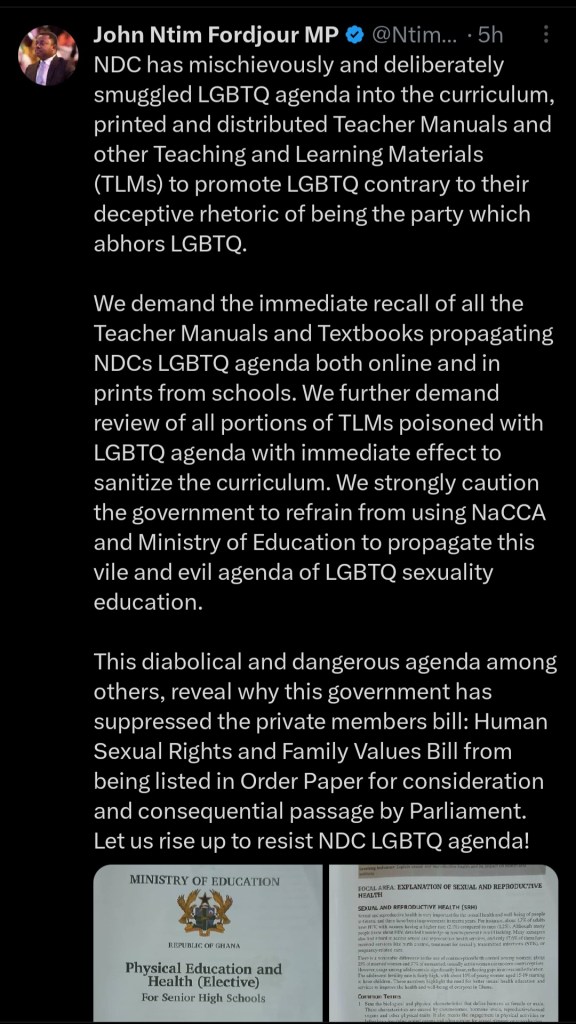
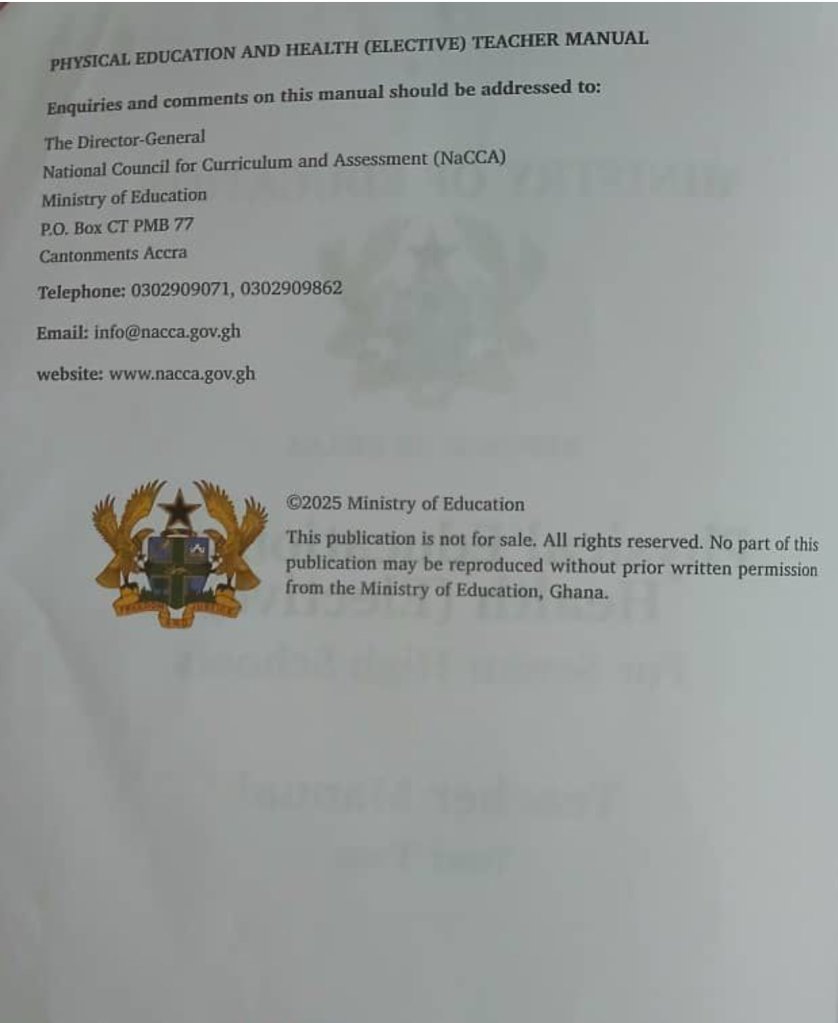
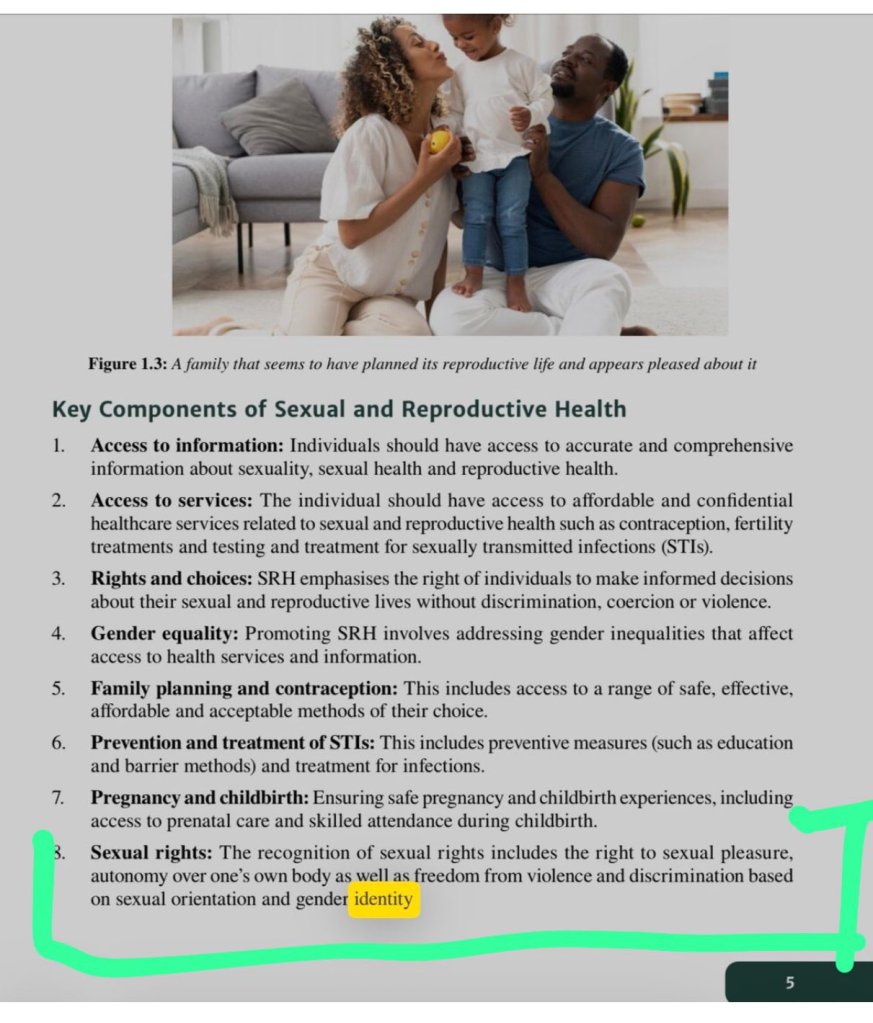
Hon. Fordjour, who is among the ten MPs who in February 2025 resubmitted the Human Sexual Rights and Family Values Bill (the anti-LGBTQ bill) to Parliament, published screenshots on X (formerly Twitter) on Tuesday, 14 January 2026, which he said proved that the government had “smuggled LGBTQ agenda” into the curriculum. The screenshots came from the Year 2 Physical Education and Health (Elective) Teacher Manual, specifically from its Sexual and Reproductive Health (SRH) section.
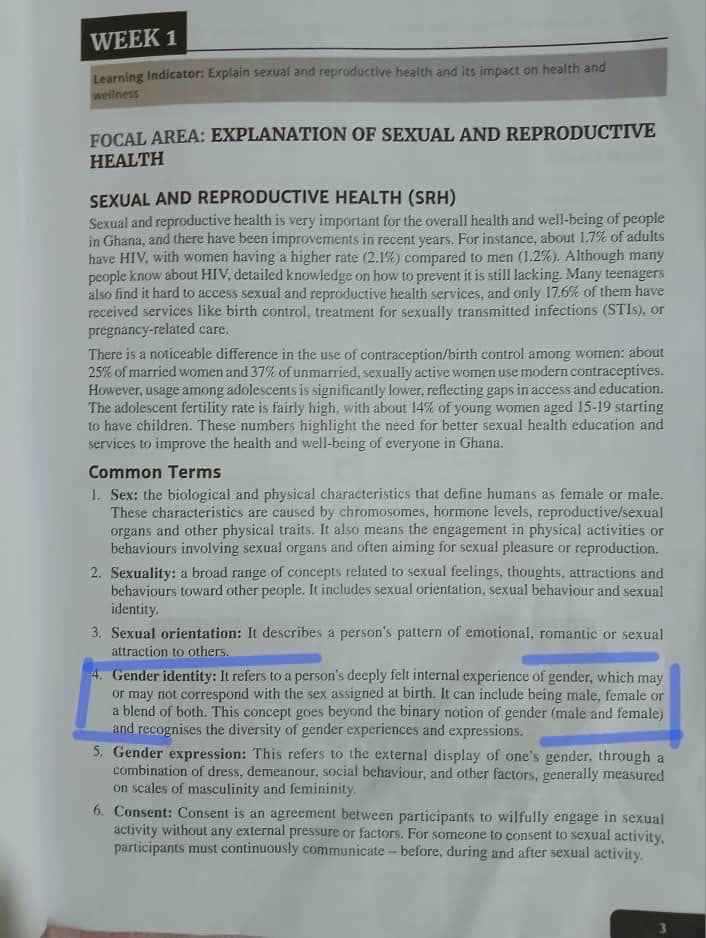
These pages included internationally-standard definitions of concepts such as sex, sexuality, sexual orientation, gender identity, sexual rights, gender equality, and consent—core components of public health and SRHR education.
Fordjour’s posts, however, framed these components as LGBTQ indoctrination. In one post, he alleged:
“NDC has mischievously and deliberately smuggled LGBTQ agenda into the curriculum… to promote LGBTQ contrary to their deceptive rhetoric of being the party which abhors LGBTQ.”

He demanded the manual’s immediate recall, calling its content “poisoned.” In another post he added:
“Find below more diabolical LGBTQ introductions smuggled by NDC in 2025 into the curriculum. NaCCA and the Ministry of Education printed and distributed Teacher Manuals laced with LGBTQ sexual education to poison our innocent students…”
These public statements triggered widespread debate and prompted NaCCA to issue clarifications addressing the claims one by one.

NaCCA’s Position: No LGBTQ Content in the National Curriculum
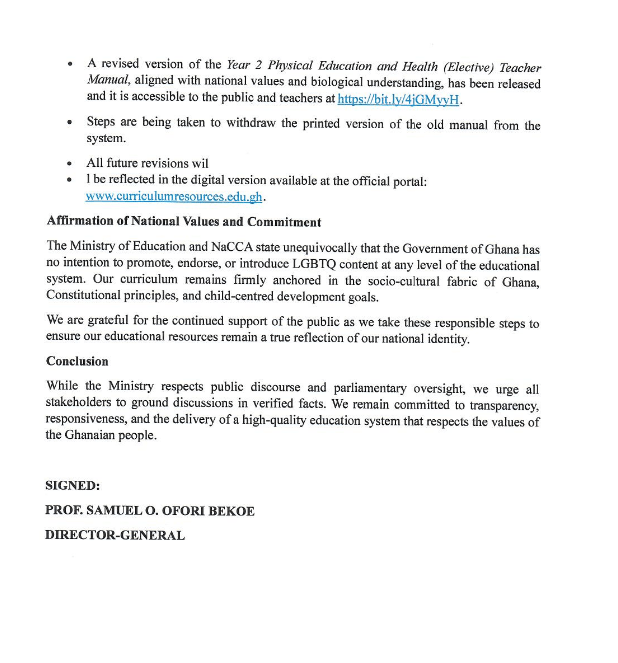
In its press release dated 13 January 2026, NaCCA flatly rejected the allegations. The Council stated:
“The Government of Ghana has no intention to promote, endorse, or introduce LGBTQ content at any level of the educational system.”
It emphasized that claims circulating on social media resulted from a mischaracterisation of the material shared by Hon. Fordjour. The extracts were not from the national curriculum, but from a Teacher Manual that provides additional instructional guidance to teachers.
NaCCA stressed three essential points:
1. The national curriculum contains no LGBTQ-related instructional content.
The curriculum is the only official, mandatory educational document. It defines what students must learn at every grade level.
2. Teacher Manuals are not curriculum.
Teacher Manuals are supplementary, optional, and non-binding. Their purpose is to help teachers interpret the curriculum—not to serve as core policy.
3. Teachers do not need to use manuals to teach the curriculum.
Manuals can be used to support teaching, but teachers are free to rely solely on the curriculum.
This clarification directly undermines the central claim made by Hon. Fordjour.
Curriculum vs. Teacher Manuals: Why the Distinction Matters
NaCCA devoted much of its statement to correcting what it views as a misunderstanding that has long fuelled misinformation: the difference between curriculum documents and support materials.
The Curriculum (What must be taught)
• This is the official national policy document.
• It defines approved learning outcomes and competencies.
• It undergoes approval through the Ministry of Education and government structures.
• It carries legal and policy authority.
• It is mandatory for all schools.
Teacher Manuals (How teachers may choose to teach the content)
• These include definitions, examples, and teaching suggestions.
• They do not prescribe learning content.
• They do not undergo the same policy approval process.
• They are revised periodically based on feedback.
• They do not constitute binding curriculum.
Thus, equating material in a Teacher Manual with “the curriculum” is factually inaccurate.

Curriculum Timeline: Developed During Fordjour’s Own Tenure
NaCCA added a key contextual element: the new SHS curriculum was introduced in the 2024/2025 academic year, at a time when Hon. Fordjour served as Deputy Minister for Education.
This matters because:
• The decision to commission Teacher Manuals was undertaken while he was in office.
• The Manuals were developed as part of the curriculum reform process initiated under his leadership.
• The Ministry endorsed the broader framework that produced the manuals.
NaCCA did not directly accuse the MP of inconsistency, but the timeline implicitly challenges the idea that the materials were introduced by a different administration with a hidden agenda.
Internal Review Findings: Definition of Gender Identity Revised
NaCCA acknowledged that its internal review team identified one definition—specifically the one describing gender identity—as not fully aligned with Ghanaian cultural norms and values.
The original manual defined gender identity as:
“A person’s deeply felt internal experience of gender, which may or may not correspond with the sex assigned at birth… This concept goes beyond the binary notion of gender…”
NaCCA stated that following review:
• A revised Teacher Manual, aligned with national values and biological perspectives, has been released.
• The printed version of the old manual is being withdrawn from schools.
• All future versions will be published digitally and made publicly accessible.
The Council framed this as part of routine quality assurance—not evidence of wrongdoing.
This Attack Targets SRHR—Not Just LGBTQ Content
The highlighted pages belong to Sexual and Reproductive Health (SRH), a core public health component
The pages circulated by Hon. Fordjour are from the SRH section, not from any curriculum segment dealing with LGBTQ identities. The listed definitions—such as sex, sexuality, consent, reproductive choices, STI prevention, and gender equality—are foundational elements of health education.
This section addresses:
• biological development;
• reproductive anatomy;
• sexual rights and freedom from violence;
• access to information and services;
• family planning;
• HIV and STI prevention;
• gender-based health disparities.
Although SRHR involves discussions of sexual orientation and gender identity within a public health framework, these do not constitute LGBTQ advocacy. They reflect global best practice in preventing:
• teenage pregnancy,
• unsafe abortion,
• sexual violence,
• sexually transmitted infections,
• child marriage,
• and HIV infections.
Why SRHR becomes a political target
SRHR education is often the flashpoint for political and moral controversies because it deals with:
• sexuality,
• bodily autonomy,
• consent,
• gender,
• and reproductive rights.
These topics become easily framed as “LGBTQ promotion,” even when no LGBTQ advocacy is present.
Historical Context: The 2019 Attack on CSE
The current controversy strongly echoes the 2019 backlash against Comprehensive Sexuality Education (CSE). In 2019:
• Anti-LGBTQ actors alleged that CSE was a plan to “teach LGBTQ in schools.”
• Religious and political groups fuelled misinformation campaigns.
• Despite assurances from government, NaCCA, and the Ministry of Education, the CSE policy was ultimately withdrawn.
• The content of the CSE guidelines was standard SRHR information—not LGBTQ advocacy.
NaCCA’s 2026 statement intentionally reminds the public that similar moral panic campaigns have previously targeted public health content, not LGBTQ materials.
The manual Fordjour shared includes definitions that appear in nearly all SRHR curricula worldwide. Yet, as in 2019, these have been reframed as a threat.
A Pattern of Politicised Attacks on Sexuality Education
The 2026 controversy fits a long and consistent pattern:
1. SRHR topics are selectively extracted and reframed as LGBTQ indoctrination.
SRHR materials commonly mention sexual rights, gender identity, and orientation as part of public health frameworks. These are widely used to educate young people about:
• consent,
• bodily integrity,
• avoiding STIs,
• and understanding sexual development.
But opponents often isolate these terms to stir fear.
2. Such controversies often emerge during political cycles.
Appeals to “protect children” and “defend family values” mobilise voters. Hon. Fordjour’s renewed activism comes at a time when:
• Parliament is reconsidering the anti-LGBTQ bill;
• political repositioning are underway;
• moral politics is a powerful electoral tool.
3. Attacks target SRHR because it threatens patriarchal and conservative power structures.
SRHR emphasizes:
• autonomy,
• informed choice,
• consent,
• gender equality,
• and human rights.
These concepts disrupt entrenched norms about gender and sexuality.
Political Motivation: Why Fordjour’s Allegations Are Seen as Strategic
Hon. Fordjour has consistently positioned himself as one of the strongest anti-LGBTQ voices in public office. His involvement in resubmitting the anti-LGBTQ bill underlines this role.
But the timing and framing of his allegations raise additional questions:
• Why attack a manual produced during reforms initiated under his tenure?
• Why frame SRHR content as LGBTQ indoctrination?
• Why amplify moral panic at this specific political moment?
• Why overlook the educational purpose of SRHR definitions in a health manual?
These questions suggest that the allegations serve a larger political narrative designed to reinforce the MP’s role as a defender of conservative values and to build momentum for the anti-LGBTQ bill’s passage.
Conclusion
NaCCA’s detailed clarification underscores the following:
• The national curriculum contains no LGBTQ content.
• The extracts circulated online are from an optional Teacher Manual, not core curriculum.
• The manual was developed within reforms initiated while Hon. Fordjour was Deputy Minister.
• The definition of gender identity has been revised, and printed copies withdrawn.
• The controversy is a renewed attack on SRHR, not a revelation of LGBTQ teaching.
• The pattern aligns with earlier misinformation campaigns, particularly the 2019 CSE backlash.
• The political context—especially the revival of the anti-LGBTQ bill—suggests the controversy is politically and strategically motivated.
Ultimately, the dispute highlights Ghana’s ongoing struggle between evidence-based public health education and politicised narratives that weaponise misinformation around sexuality, gender, and rights. The stakes in these debates extend beyond the classroom—they shape national policy, public opinion, and the lives of young people who depend on accurate, culturally grounded, and life-saving health information.
Here is a copy of the document the MP cited:
 Rightify Ghana