
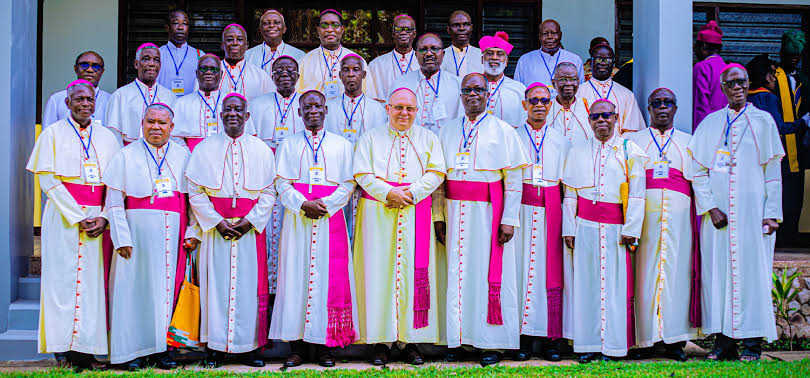
The Ghana Catholic Bishops’ Conference (GCBC) has issued a strongly worded press release on what it calls “curriculum content and the integrity of Ghanaian education,” following the public controversy over parts of a Year 2 Senior High School Physical Education and Health Teacher’s Manual that circulated online in recent days.
In the statement—issued Friday, January 16, 2026 and signed by Most Rev. Matthew Kwasi Gyamfi, Bishop of Sunyani and President of the GCBC—the Bishops say their intervention is motivated by “deep pastoral concern” for children and young people, and by what they describe as the duty to protect Ghana’s moral and cultural foundations.
“Deep pastoral concern” and the primacy of family in moral formation
The GCBC frames the dispute as larger than one manual, arguing it touches the moral direction of education as a whole. The Bishops state they are speaking from “deep pastoral concern for the moral, cultural, and spiritual formation of our children and young people.”
They emphasise that the family is central to values education, describing it as “the foundational unit of society and the first school of virtue, faith, and conscience.”
From their perspective, schooling should complement—not displace—parental responsibility. They argue that education “must respect parental authority,” “honour Ghanaian cultural identity,” and “uphold the shared values that bind our nation together.”
What triggered the statement: a manual seen as inconsistent with Ghanaian values
The Bishops say the controversy emerged after “the circulation of a Year 2 Senior High School Physical Education and Health Teacher’s Manual containing definitions and concepts inconsistent with Ghana’s cultural, biological, and moral understanding of the human person.”
They describe public reaction as both predictable and legitimate, saying the development caused “understandable anxiety among parents, educators, and citizens who perceived a threat to traditional conceptions of family, personhood, and moral formation.”
Notably, the Bishops place the controversy within the broader national contestation around sexuality, identity, and moral education—suggesting the concern is not merely about technical drafting but about worldview and social direction.
On LGBTQ: Bishops welcome NaCCA’s clarification but insist deeper problems remain
A key portion of the GCBC statement addresses the core public dispute—whether Ghana’s curriculum had introduced LGBTQ content. The Bishops say they “acknowledge and welcome the clarification” from NaCCA that “the officially approved national curriculum does not include LGBTQ-related lessons.”
They also praise NaCCA’s corrective response, stating: “We commend NaCCA for withdrawing the offending material and issuing a revised manual aligned with national norms and values.”
However, the GCBC argues that NaCCA’s withdrawal and revision—while important—does not resolve what they consider the underlying governance issue. The Bishops say they remain convinced the episode “reveals deeper weaknesses in oversight, consultation, and value alignment within curriculum development processes.”
They connect this to institutional legitimacy, warning that “public trust in education depends on transparency, accountability, and fidelity to constitutional and moral principles.”
Endorsing public pressure: Bokpin and Foh-Amoaning cited
In a notable move, the Catholic Bishops explicitly reference two public figures who have been outspoken in demanding accountability. The statement “acknowledge[s] the public advocacy of Prof. Godfred A. Bokpin and Mr. Moses Foh-Amoaning,” noting their calls for “a formal apology and an independent review.”
The Bishops argue these interventions reflect a wider civic expectation that education policy must remain anchored in national identity and constitutional values: “education policy must remain rooted in Ghana’s cultural heritage, constitutional values, and moral integrity.”
This reference signals that the GCBC is not only making a moral argument but is aligning itself with demands for procedural and institutional accountability.
GCBC says a position paper is ready for government and education agencies
Beyond commentary, the Bishops indicate they intend to formally engage state institutions. They state that their “position paper on the matter is ready to be formally submitted” to the Government of Ghana, NaCCA, the Ministry of Education, and the Ghana Education Service.
They describe their intention as “constructive engagement, institutional reform, and the strengthening of trust between families, schools, and the state.”
“Core convictions”: Parents first, age-appropriateness, and democratic participation
The press release outlines five “core convictions,” which read as a proposed framework for how Ghana should govern sensitive education content.
- Parents First: “Parents are the primary educators of their children,” and schools must “partner with families, not replace them, in moral and value formation.”
- Age-Appropriate Learning: “Sensitive or contested topics should not be introduced prematurely or without parental involvement.”
- Subsidiarity in Governance: Curriculum processes “must be transparent and accountable,” even as government ensures quality education.
- Cultural and Moral Coherence: Educational content must reflect Ghana’s “cultural and religious values,” upholding “human dignity, family life, and moral responsibility.”
- Democratic Accountability: Curriculum development should involve “parents, educators, civil society, religious bodies, and traditional authorities” to secure legitimacy and trust.
This list is significant because it moves the GCBC’s intervention from a general moral position into concrete governance expectations—especially about participation, oversight, and parental involvement.
Education as a “sacred trust” and a warning against “disorientation”
The Bishops situate their view in Catholic teaching and Ghanaian cultural tradition. They describe education as “a sacred trust,” referencing Gravissimum Educationis and arguing education is for “complete formation” and “the good of society.”
They then connect the current controversy to a broader cultural claim: Ghana’s traditions transmit “enduring moral wisdom,” including “respect, honesty, diligence, solidarity, and reverence for life.”
In one of the statement’s most pointed lines, they warn that when materials introduce concepts “detached from these moral roots,” the result is “not enlightenment but disorientation.”
At the same time, the Bishops try to balance moral firmness with a rejection of violence, stating: “education must promote critical thinking, compassion, and respect for human dignity.” They add that children can be taught “to reject prejudice and violence” without adopting frameworks that contradict faith or cultural worldview.
The way forward: audit, stakeholder dialogue, and “ethical oversight committees”
The GCBC calls for structural reforms rather than only corrective edits. They demand “a comprehensive review of curriculum development and editorial processes,” with special attention to “transparency, accountability, and value alignment.”
They also urge NaCCA and the Ministry of Education to “conduct an audit to determine how unauthorised content entered teacher materials” and to strengthen safeguards to prevent recurrence.
In addition, the Bishops call for “regular stakeholder dialogue” bringing together parent associations, teacher unions, religious and traditional leaders, and education experts. They further propose “ethical oversight committees” composed of educators, theologians, and cultural experts to vet materials dealing with “personal identity, relationships, or sexuality.”
Finally, they advocate “stronger parental involvement” and “open, timely, and consistent communication by education authorities” as a means of preventing future national disputes.
Conclusion: “Safeguarding the soul” of Ghanaian education
The statement ends with a broad national appeal. The Bishops say education is not only about labour-market preparation but about forming “upright citizens, guided by conscience, rooted in truth, and committed to the common good.”
They argue Ghana’s “reverence for God,” “respect for family,” and “devotion to community” must continue to shape what children learn.
In a final call to collective action, they urge parents, teachers, policymakers, and religious leaders to join them in “safeguarding the soul of Ghanaian education,” and to ensure that “knowledge and virtue walk hand in hand.”
 Rightify Ghana