
The Human Sexual Rights and Family Values Bill, 2025, commonly known as the anti-LGBTQ+ bill, has officially been introduced for consideration in the Parliament of Ghana. According to a public announcement issued by Parliament, the Bill received its First Reading on 17 February 2026 in accordance with Article 106 of the 1992 Constitution of Ghana.
Following parliamentary procedure, the Rt. Hon. Speaker has referred the Bill to the Committee on Constitutional and Legal Affairs and the leadership of the Committee on Human Rights for detailed consideration and reporting. As part of the legislative process, Parliament has invited the general public to submit memoranda providing views, analysis, and recommendations regarding the proposed law.
This stage of the legislative process presents an important opportunity for human rights defenders, civil society organisations, academics, legal practitioners, faith leaders, and concerned citizens to contribute to the national conversation and provide evidence-based input on the potential legal, constitutional, and social implications of the Bill.
Understanding the Bill
The Human Sexual Rights and Family Values Bill, 2025 is a reintroduction of a previous legislative proposal that was passed by Parliament in 2024 but later lapsed before receiving presidential assent. The newly introduced version contains nineteen (19) clauses, reduced from the twenty clauses in the earlier version. Despite this numerical reduction, the substantive provisions remain largely similar in structure and intent.
If enacted, the Bill would introduce a wide range of criminal offences and regulatory measures affecting individuals, families, institutions, media platforms, and organisations. Its provisions extend beyond the criminalisation of same-sex relations to include identity, expression, advocacy, healthcare, education, association, funding, and digital communication.
Among its key provisions are:
- Up to three years’ imprisonment for identifying as LGBTQ+ or “holding out” as LGBTQ+.
- Five to ten years’ imprisonment for promoting LGBTQ+ rights, publishing supportive materials, or providing services perceived as supporting LGBTQ+ persons.
- Criminal liability for organisations and individuals who fund, sponsor, or support activities interpreted as promoting LGBTQ+ rights.
- Mandatory reporting obligations, requiring citizens to report individuals suspected of engaging in prohibited acts.
- Restrictions on education and public information, including prohibitions on LGBTQ-inclusive educational content.
- Prohibitions on gender-affirming healthcare and other forms of medical support related to gender identity.
- Dissolution and prohibition of organisations perceived to advocate for or support LGBTQ+ rights.
The Bill also proposes amendments to the , making offences created under the law extraditable offences. This means individuals accused under the Act could potentially face extradition requests through international legal cooperation frameworks, including mechanisms facilitated by INTERPOL. Such provisions raise complex legal and diplomatic questions regarding treaty obligations, dual criminality standards, and international human rights protections.
Below is a copy of the current bill
Constitutional and Human Rights Concerns
Legal scholars, human rights organisations, and civil society groups have raised serious concerns about the potential impact of the Bill on constitutional rights guaranteed under the 1992 Constitution of Ghana. These concerns relate to the protection of fundamental freedoms, including:
- Freedom of expression
- Freedom of association and assembly
- Privacy and dignity of the person
- Access to healthcare and social services
- Equality before the law
Critics argue that the broad and expansive definitions within the Bill could result in criminal liability for individuals who are not engaged in any criminal conduct, including journalists, educators, healthcare providers, community organisers, and family members who provide support to LGBTQ+ persons.
Additionally, the Bill may create an environment in which citizens are compelled to report one another, potentially contributing to social division, fear, and abuse of the law through false accusations or harassment.
Rising Climate of Fear and Discrimination
Over the past year, LGBTQ+ Ghanaians have reported increasing levels of discrimination and violence, often fuelled by hostile rhetoric in public discourse. Many individuals have faced job loss, housing eviction, family rejection, and social exclusion, even before the enactment of new legal penalties.
Human rights organisations have warned that the passage of the Bill could further exacerbate these challenges by legitimising discrimination and expanding the legal basis for persecution and harassment.
Beyond domestic impacts, observers have also cautioned that the legislation could generate significant diplomatic and economic implications for Ghana. Concerns have been raised about potential tensions with international partners, human rights treaty bodies, and multilateral institutions, particularly where obligations under international law may conflict with the enforcement of the proposed legislation.
Parliament Calls for Public Memoranda
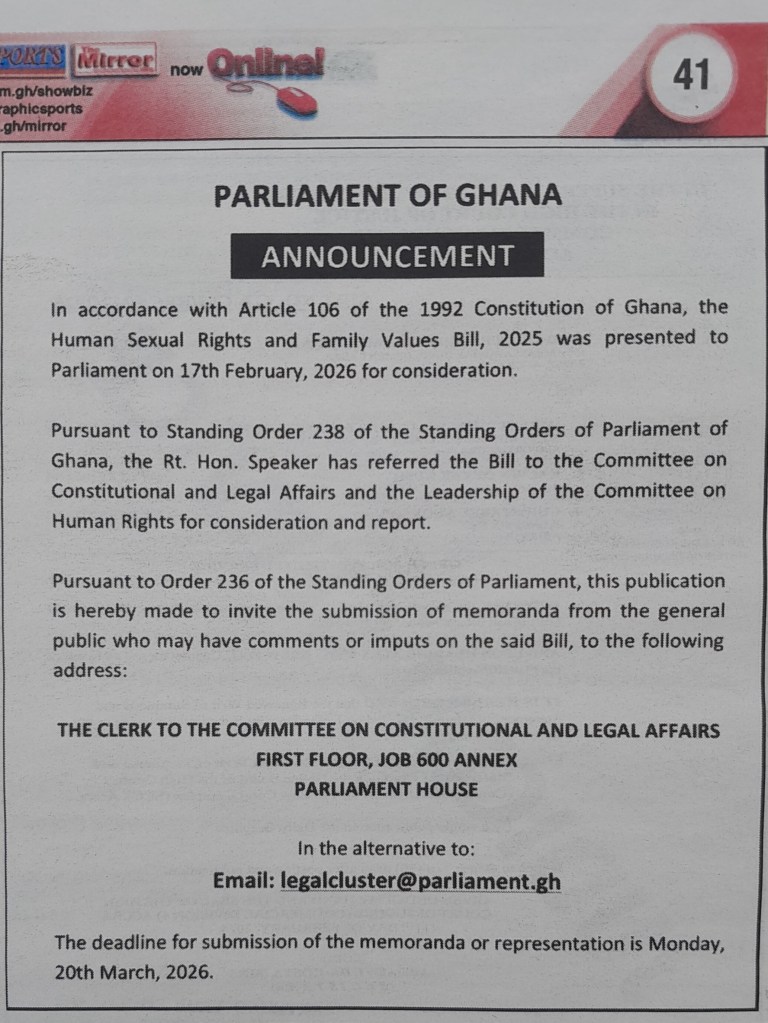
As part of the legislative review process, Parliament has formally invited members of the public to submit memoranda outlining their views on the Bill.
Submissions should be addressed to:
The Clerk to the Committee on Constitutional and Legal Affairs
First Floor, Job 600 Annex
Parliament House
Accra, Ghana
Alternatively, memoranda may be submitted by email to:
legalcluster@parliament.gh
The deadline for submissions is Friday, 20 March 2026.
A Call to Human Rights Defenders and Civil Society
This moment represents a critical opportunity for human rights defenders, civil society organisations, professional associations, faith leaders, academics, lawyers, and community members to engage constructively in Ghana’s democratic process.
Rightify Ghana encourages stakeholders to prepare and submit thoughtful and evidence-based memoranda that examine:
- Constitutional implications of the Bill
- Human rights obligations under regional and international law
- Public health considerations
- Impact on civil society and humanitarian work
- Potential diplomatic and economic consequences
- Recommendations for protecting the rights and dignity of all persons in Ghana
Public participation in the legislative process is an essential component of democratic governance. By contributing informed perspectives, stakeholders can help ensure that laws enacted in Ghana uphold constitutional principles, human dignity, and the rule of law.
Below is a copy of the announcement as advertised in the Daily Graphic newspaper on Wednesday, March 11. 2026
Financial and Institutional Implications for the State
Although the Human Sexual Rights and Family Values Bill, 2025 has been introduced as a Private Members’ Bill, its implementation would still impose significant financial and administrative costs on the State. Under Article 108 of the , Parliament is generally restricted from passing private members’ legislation that imposes charges on public funds unless such expenditures are authorised by the Executive. However, several provisions of the Bill would inevitably require substantial government expenditure if implemented.
For example, the proposed amendment to the would make offences under the Bill extraditable. Extradition processes involve complex and costly legal, diplomatic, and law enforcement procedures, including investigations, arrest operations, international legal correspondence, court proceedings, detention costs, and transportation of suspects between jurisdictions. These processes often require cooperation with international policing mechanisms coordinated through organisations such as , which further increases administrative and operational costs.
Beyond extradition, the enforcement of the Bill would likely require expanded policing, prosecution, judicial proceedings, and correctional facility capacity, placing additional pressure on already limited public resources. The establishment of regulatory mechanisms, investigation of alleged offences, management of reporting obligations, and prosecution of cases could significantly increase the workload of law enforcement agencies, prosecutors, and the courts.
These financial and institutional implications raise important questions about public expenditure priorities, particularly at a time when Ghana continues to address economic recovery challenges and competing demands on public resources such as healthcare, education, and infrastructure.
For this reason, stakeholders preparing memoranda may wish to examine not only the constitutional and human rights implications of the Bill, but also its fiscal and administrative consequences for the State.
Defending Ghana’s Democratic Values
Ghana has long been recognised as a leader in democratic governance in Africa. The strength of this democratic tradition lies in robust civic engagement, respect for fundamental rights, and the ability of citizens to participate meaningfully in shaping public policy.
This development comes as the Parliament of Ghana prepares to host the anti-LGBTQ+ 4th African Inter-Parliamentary Conference on Family, Sovereignty and Values in Accra from May 27–30, 2026—the first time the conference will be held in West Africa—bringing together lawmakers from across the continent to discuss policies framed around “family values,” amid growing concerns from human rights observers about coordinated efforts to advance anti-LGBTQ legislation across the region.
The invitation for memoranda provides an important avenue for dialogue and reflection on how Ghana can continue to uphold these values while addressing complex social and cultural issues.
Rightify Ghana calls on all individuals and organisations committed to justice, human rights, and democratic governance to make their voices heard by submitting memoranda to Parliament and participating actively in this national conversation.
 Rightify Ghana