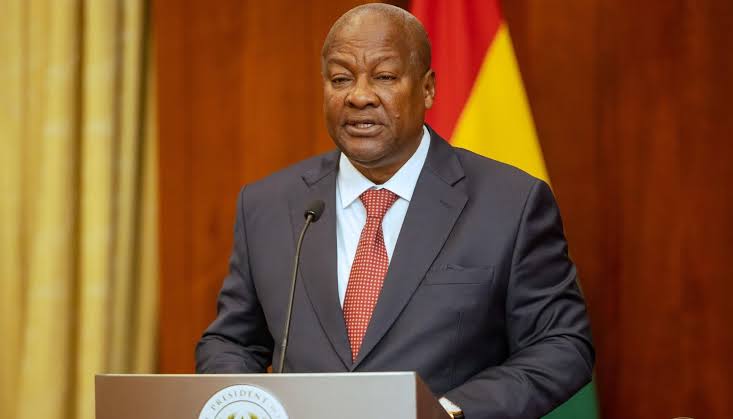
A planned visit by Ghana’s President, John Dramani Mahama, to Lincoln University in the United States has been abruptly cancelled, sparking diplomatic concern and renewed international attention on Ghana’s controversial Human Sexual Rights and Family Values Bill, 2025, popularly known as the anti-LGBTQ+ bill.
The visit, which was scheduled for Thursday, 26 March 2026, was expected to include the conferment of an honorary doctorate degree (honoris causa) on President Mahama. However, in a brief public notice, the University announced that “due to unforeseen circumstances,” the visit had been cancelled.
Ghana Embassy Expresses “Profound Disappointment”
In a strongly worded statement issued on 24 March 2026 in Washington, D.C., the Embassy of Ghana in the United States expressed “profound disappointment” over what it described as a last-minute decision by the University.
According to the Embassy, preparations for the visit had been fully completed following extensive prior engagement between both parties. Officials from the Embassy and the University had reportedly conducted a final walkthrough and confirmed all logistical and programmatic arrangements just days before the scheduled event.
The Embassy noted that the sudden reversal came after concerns were raised by a group regarding President Mahama’s perceived stance on Ghana’s anti-LGBTQ legislation currently before the Parliament of Ghana.
“It is therefore both surprising and regrettable,” the statement said, “that concerns have emerged at such an advanced stage… without prior engagement or clarification.”
The Embassy further emphasised that:
- The invitation had been formally extended and accepted in good faith.
- All arrangements had been concluded.
- The President had already arrived in the United States, specifically New York, in anticipation of the visit.
While acknowledging the University’s autonomy, the Embassy cautioned that the concerns raised relate to ongoing legislative processes in Ghana, not the unilateral position of any individual.
Link to Ghana’s Anti-LGBTQ Bill
The controversy comes at a time when Ghana is once again debating the Human Sexual Rights and Family Values Bill, 2025, currently before the Parliament of Ghana.
The Bill, which has been reintroduced in the 9th Parliament after a previous version lapsed, proposes sweeping criminal provisions including:
- Jail terms for individuals who identify as LGBTQ+
- Criminalisation of advocacy, funding, and support
- Restrictions on education, healthcare, and media expression
- Mandatory reporting of suspected offences
- Amendments to the Extradition Act, 1960 to make such offences extraditable
Human rights observers have warned that the Bill could significantly impact constitutional freedoms and civic space, while also attracting growing international scrutiny.
Growing International Attention and Pressure
Lincoln University’s decision reflects a broader pattern of increasing global attention to Ghana’s legislative direction on LGBTQ rights. Advocacy groups and academic communities in the United States and elsewhere have raised concerns about engagement with public officials perceived to support or not oppose such legislation.
The situation also highlights how domestic legislative processes are increasingly shaping international relations, academic partnerships, and diplomatic engagements.
Notably, Lincoln University has historic ties to Ghana, including its association with Ghana’s first President, Kwame Nkrumah, making the cancellation particularly symbolic.
Timing Amid Major Continental Conference
The development comes at a critical moment, as the Parliament of Ghana prepares to host the 4th African Inter-Parliamentary Conference on Family, Sovereignty and Values in Accra from 27–30 May 2026.
The conference, being held in West Africa for the first time, is expected to bring together lawmakers from across the continent to deliberate on policies framed around “family values.” However, human rights observers have expressed concern that such platforms may contribute to coordinated regional efforts to advance anti-LGBTQ legislation.
Diplomatic and Policy Implications
The cancellation of President Mahama’s visit underscores the emerging diplomatic and reputational implications of the Bill. As Ghana navigates both domestic legislative debates and international partnerships, tensions may arise between:
- Democratic legislative processes at home
- International human rights expectations
- Academic and diplomatic relationships abroad
The Embassy, in its statement, reaffirmed its commitment to constructive dialogue and mutual respect, expressing hope that the longstanding relationship between Ghana and Lincoln University would guide a balanced resolution.
Sam George Slams Lincoln University
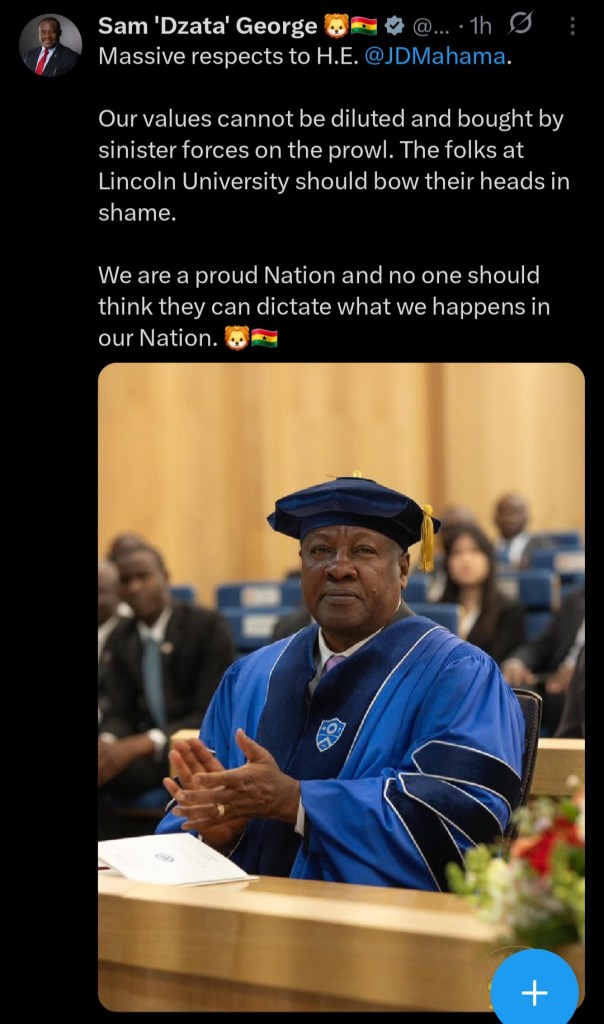
Samuel Nartey George, Member of Parliament for Ningo-Prampram, Minister for Communication, Digital Technology and Innovations, and a key sponsor of the Human Sexual Rights and Family Values Bill, 2025, strongly criticised Lincoln University following its decision to cancel President John Dramani Mahama’s visit and honorary award. In a social media post, he praised the President for what he described as upholding Ghanaian values and not compromising them for international recognition. He further condemned the University’s decision, stating that its officials should “bow their heads in shame,” and argued that Ghana’s sovereignty and cultural values should not be influenced or dictated by external actors, particularly in relation to debates around the anti-LGBTQ Bill currently before the Parliament of Ghana.
A Defining Moment
This incident marks a significant moment in Ghana’s ongoing debate over the Human Sexual Rights and Family Values Bill, 2025. It illustrates how the Bill’s implications extend far beyond national borders—affecting diplomacy, global perception, and international engagement.
As Parliament continues its consideration of the Bill and invites public memoranda, the intersection of law, human rights, and international relations is becoming increasingly evident.
 Rightify Ghana