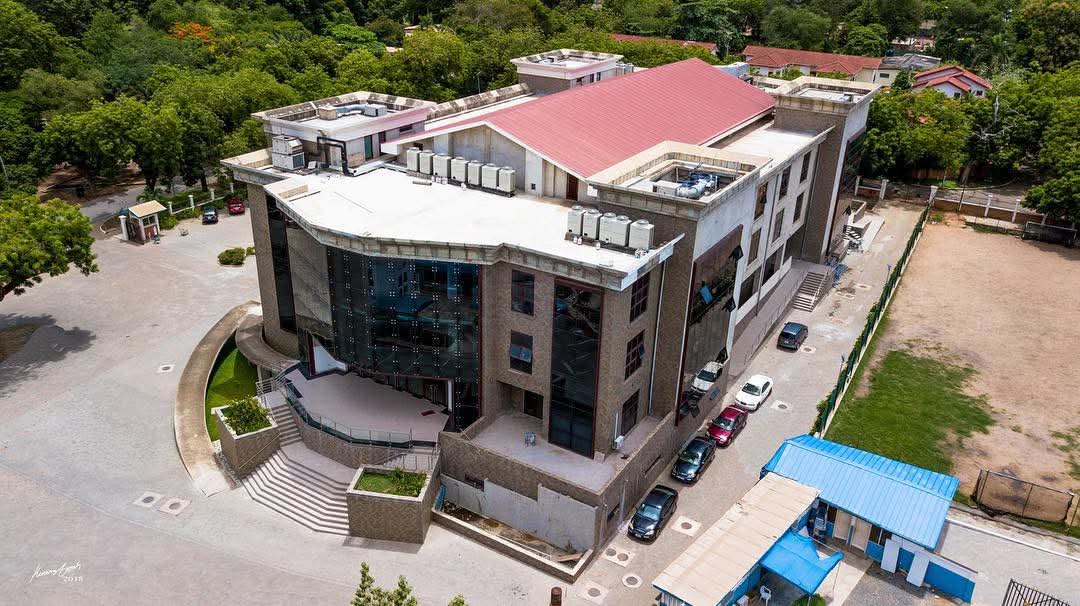
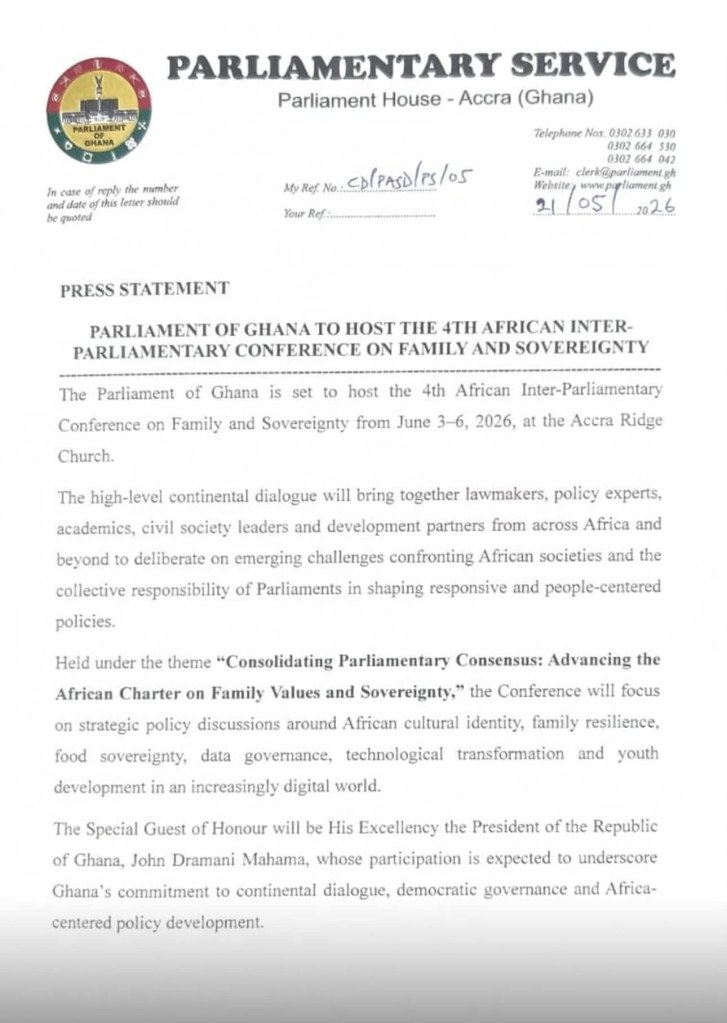
The Parliament of Ghana has officially confirmed that the upcoming 4th African Inter-Parliamentary Conference on Family Values and Sovereignty will take place from June 3–6, 2026 at the Accra Ridge Church, with President John Dramani Mahama expected to serve as Special Guest of Honour at the controversial gathering widely criticised by human rights advocates as an anti-LGBTQ and anti-rights conference.
The announcement was made in a new press statement issued by the Parliamentary Service on May 21, 2026, marking a significant venue change from earlier conference information published on the event’s official website, which identified the Four Points by Sheraton Accra Airport as the official conference venue. As of the latest review, however, the Four Points by Sheraton remains listed on the conference website alongside registration and accommodation arrangements, raising questions about whether aspects of the event, accommodation logistics, or side meetings may still be connected to the hotel.
The conference website – hosted on 4thfamilyvalues.parliament.gh, a subdomain of the official Parliament website – continues to provide participant registration links and travel coordination information for delegates expected to attend both physically and virtually from across Africa and beyond.
Registration and Accommodation Processes Underway
Conference organisers have already opened registration, accommodation reservations, and travel itinerary submissions for participants.
Published timelines include:
- Registration Period: May 8–25, 2026
- Accommodation Reservations: May 8–25, 2026
- Submission of Travel Itineraries: May 8–30, 2026
- Official Arrival: June 2, 2026
- Conference Dates: June 3–6, 2026
- Official Departure: June 6, 2026
Hotels listed on the conference website include:
- Four Points by Sheraton Accra Airport
- Lancaster Accra Hotel
- The Palms by Eagles
- Ibis Styles Accra Airport
- Best Western Premier Accra Airport Hotel
- Accra Marriott Hotel
- Tang Palace Hotel
- Airport View Hotel
The conference was initially expected to take place in late May before being rescheduled to June. While organisers have not publicly explained the change, Rightify Ghana believes the adjustment may have been influenced by the timing of Eid al-Adha celebrations and parliamentary scheduling considerations.
Parliament Frames Conference Around “Family Values and Sovereignty”
In its official statement, Parliament described the gathering as a “high-level continental dialogue” that will bring together lawmakers, academics, policy experts, civil society leaders, and development partners from across Africa and beyond.
Held under the theme:
“Consolidating Parliamentary Consensus: Advancing the African Charter on Family Values and Sovereignty,”
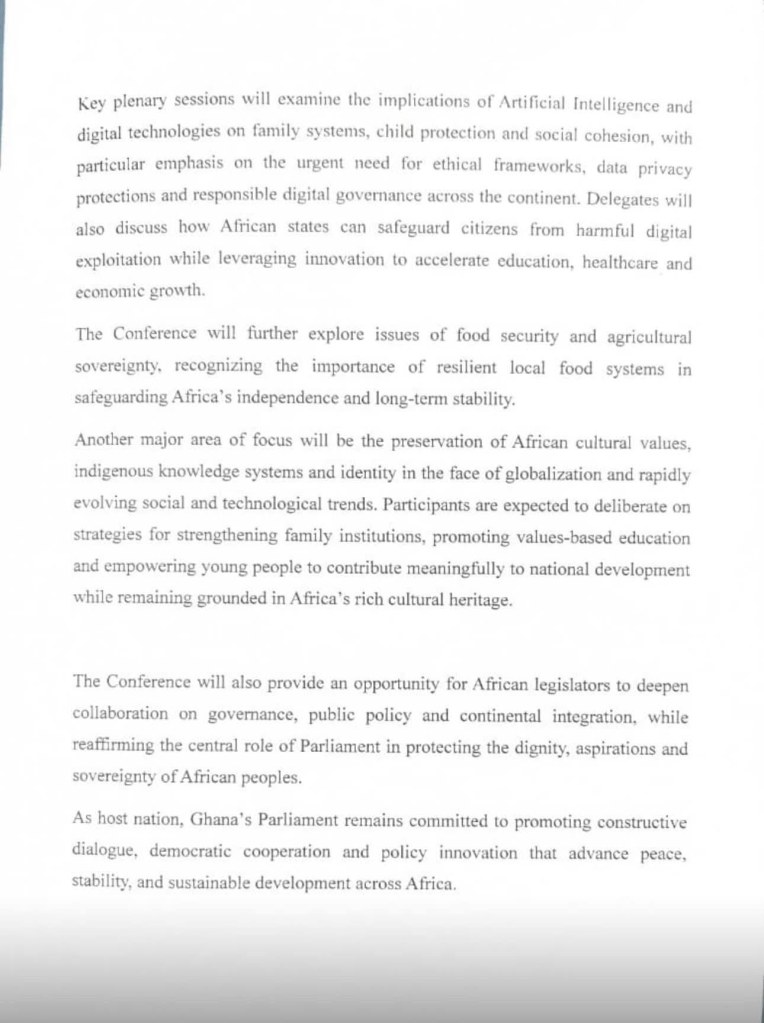
the conference will reportedly focus on:
- African cultural identity
- Family resilience
- Food sovereignty
- Artificial Intelligence and digital governance
- Child protection
- Social cohesion
- Youth development
- Data governance
Parliament said President Mahama’s expected participation would underscore Ghana’s commitment to “continental dialogue,” “democratic governance,” and “Africa-centered policy development.”
Key plenary discussions are also expected to examine the impact of Artificial Intelligence and digital technologies on family systems and governance frameworks, while emphasising ethical regulation, data protection, and digital sovereignty.
Critics Warn Proposed Charter Threatens Human Rights Protections Across Africa
Despite official framing around governance, sovereignty, and culture, human rights advocates argue that the conference forms part of a broader transnational anti-rights movement targeting women’s rights, LGBTQI+ rights, sexual and reproductive health and rights (SRHR), civic freedoms, and democratic participation across Africa.
The conference is being coordinated by organisations including the Inter-parliamentary Network on Family Values, Family Watch Africa, African Bar Association, and the Foundation for African Heritage.
Observers have also highlighted the influence of Family Watch International, a US-based conservative organisation designated as a hate group by the Southern Poverty Law Center.
Central to the conference agenda is the proposed Draft African Charter on Family, Sovereignty and Values (FSV), a controversial initiative seeking to institutionalise heterosexual family structures, parental authority, and state sovereignty over social policy while opposing LGBTQ+ rights, abortion access, comprehensive sexuality education, and broader gender justice frameworks.
Human rights advocates warn that the proposed Charter threatens existing protections under African and international human rights systems, particularly those relating to equality, non-discrimination, bodily autonomy, and freedom of expression and association. Critics say the initiative could weaken or undermine instruments such as the Maputo Protocol by reframing women’s rights and reproductive health protections as foreign or anti-family concepts.
Civil society organisations and human rights defenders have also raised alarm that the Charter could be used to justify increased state restrictions on NGOs, advocacy organisations, feminist movements, LGBTQI+ groups, journalists, academics, and community organisers. Observers warn that the framework risks shrinking civic space by portraying dissenting voices, rights-based advocacy, and international human rights engagement as threats to African sovereignty and cultural identity.
Advocates further caution that similar “family values” frameworks in other contexts have been accompanied by increased surveillance, criminalisation of advocacy, online censorship, harassment of human rights defenders, attacks on women’s rights organisations, and restrictions on access to sexual and reproductive healthcare information and services.
Uganda–Ghana Collaboration Intensifies
Preparations for the conference have involved sustained parliamentary and diplomatic coordination between Ghanaian and Ugandan officials.
On April 16, 2026, a Ugandan parliamentary delegation led by Sarah Opendi visited Ghana and held meetings with the Parliament of Ghana and the Ministry of Communications, Digital Technology and Innovations.
The delegation met with Second Deputy Speaker Andrew Asiamah Amoako, anti-LGBTQ bill sponsor John Ntim Fordjour, and Clerk to Parliament Ebenezer Ahumah Djietror.
They also held bilateral talks with Communications Minister Samuel Nartey George regarding conference coordination and efforts to elevate conference outcomes to the African Union level through formal policy processes.
The meetings followed earlier Uganda–Ghana parliamentary exchanges, including an October 2025 lobbying visit by Ugandan MPs and a February 2026 benchmarking trip by Ghanaian lawmakers to Uganda shortly before Ghana’s anti-LGBTQ bill received its First Reading in Parliament.
African Bar Association Conference Raised Additional Alarm
Concerns surrounding the proposed Charter intensified further during the 2025 Annual Conference of the African Bar Association held in Accra.
One major session focused specifically on “Towards an African Charter of Family Sovereignty and Values,” chaired by Augustine Richard Kakeeto and featuring Amb. Omer Dahab F. Mohamed, Hon. Ashems Christopher Songwe, Angela Dwamena-Aboagye, PhD, and Charles Kanjama SC.
Human rights advocates warned that the Charter’s increasing visibility within major legal and parliamentary forums reflected growing institutional support for a framework critics say threatens protections relating to women’s rights, equality, reproductive rights, and non-discrimination.
It was also during the same conference that speakers reportedly criticised Ghana’s Affirmative Action (Gender Equity) Act, 2024, which mandates gender-responsive policies and progressive targets for women’s representation in leadership and decision-making positions.
Longstanding Pattern of Anti-LGBTQ Mobilisation in Ghana
Observers say the 2026 conference reflects a broader and longer-running pattern of transnational anti-LGBTQ mobilisation in Ghana.
In 2019, the World Congress of Families hosted a regional conference in Accra that brought together political, religious, and advocacy actors opposed to LGBTQ rights and comprehensive sexuality education.
That same year, coordinated campaigns contributed to the withdrawal of Ghana’s proposed Comprehensive Sexuality Education policy following intense backlash. Analysts note that alliances strengthened during that period later contributed to the drafting and introduction of the Human Sexual Rights and Family Values Bill in 2021.
For critics, the upcoming conference therefore represents not simply a parliamentary gathering, but part of a broader continental effort to consolidate anti-rights legal, political, and ideological frameworks across Africa.
 Rightify Ghana